
Quick answer
Checked September 2026.
- Temperature: it does not freeze, but it is damp, cold and often grey. In the city, December and January days are about 10–12°C and nights about 6–8°C.
- Snow: it hardly ever snows in the city. To see snow, go up into the mountains: Fairy Mountain (Xiannüshan) or Jinfo Mountain.
- Sun and fog: there is very little sun. December and January get only 17–18 hours of sunshine a month. Fog often hides the long views, but the night views go ahead as normal.
November to February, month by month
| Month | Day high / night low (°C) | Rain days | Sunshine (hours a month) |
|---|---|---|---|
| November | 17 / 13 | 11 | 35 |
| December | 12 / 8 | 11 | 18 |
| January | 10 / 6 | 10 | 17 |
| February | 14 / 8 | 9 | 33 |
1991–2020 normals for Shapingba station, which stands for the city centre, from the China Meteorological Administration.
By the Chongqing weather service's definition (five days in a row with a daily mean below 10°C), the city centre usually only enters winter around mid-December. In weather terms, November is still autumn.
For how to choose between all twelve months, see the best time to visit Chongqing.
Fog
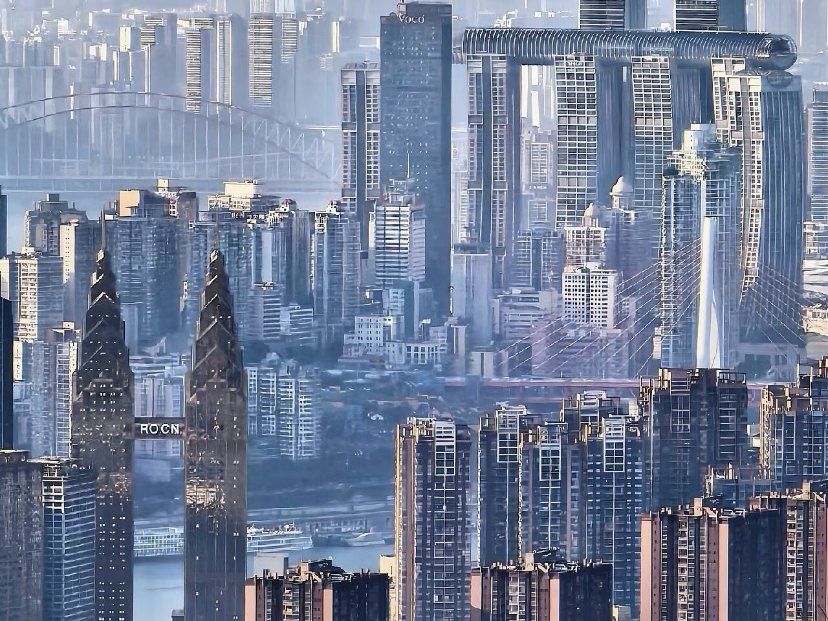
Chongqing winters are foggy with little sun, and the city is one of the least sunny places in China. Across China as a whole, December has the most fog days, followed by November and January.
On a foggy day you cannot see far. Things close by are not affected: the lanes, Hongya Cave, hotpot places and the night views. What we do: on a heavy fog day, we swap the long-view stop for a close-up one, and the evening route goes ahead.
Indoors can feel worse than outside: no central heating
Chongqing has no city-wide central heating like northern China. Homes are heated with air conditioners and electric heaters. In the words of the Chongqing Municipal City Administration Bureau: the average winter temperature is 7.9°C, damp and cold, and it feels much worse than the same temperature in the severely cold north.
What to wear
- Plan for days of about 10–12°C and nights of about 6–8°C in December and January. It does not freeze.
- The cold is damp. The city administration says it feels much worse than the same temperature in the north.
- Indoors is not always warmer. There is no city-wide central heating, so rooms can feel worse than the street.
- Bring clothes you can add and take off in layers: you get warm walking outside, then cold again in old buildings and teahouses with no air conditioning on.
Where to see snow
The city centre hardly ever gets snow: less than half a day a year on average. The snow is up in the high mountains:
| Fairy Mountain (Wulong) | Jinfo Mountain (Nanchuan) | |
|---|---|---|
| Altitude | 1,650–2,033 m, about 1,900 m on average | Up to 2,238 m |
| Recent snow seasons | 21 December 2024 to 28 February 2025; opened 27 December 2025 and ran to the end of February 2026 | 6 December 2024 to the end of February 2025; opening ceremony 30 December 2025 (the north slope ski area had already opened on 25 November) |
| How the snow comes | Natural snowfall; the ski area opens only once conditions allow | Snow lies for more than three months in winter; with man-made snow, skiing can start in mid-November |
The scenic areas have not yet announced the dates for the 2026–27 snow season. In past years they came out in December.
Fairy Mountain or Jinfo Mountain?
- Fairy Mountain: about 1,900 m on average, with a long snow cover in winter. For the 2025–26 season it added an intermediate slope and opened night skiing. It fits in the same day as the Three Natural Bridges and Longshui Gorge.
- Jinfo Mountain: up to 2,238 m, one of the places in the Chongqing metropolitan area where snow lasts longest, with the largest ski area in the city (2024–25 season: three beginner slopes and one intermediate). In winter there is rime ice on the trees, and there are hot springs at the foot of the mountain, so you can play in the snow up top and soak below.
- Only one day, and you want to see the Three Natural Bridges too: choose Fairy Mountain. Just snow and a hot spring: choose Jinfo Mountain.
Getting there on a snow day
- Train: since June 2025, high-speed trains from Chongqing East to Wulong South take 39 minutes at the fastest, with more than 20 a day.
- Crowds: over the 2026 New Year holiday, Wulong had 168,000 visitors, second in the city only to Hongya Cave.
- Heavy snow can close the park: in the blizzard of 2 January 2026, Fairy Mountain closed temporarily and roads above 1,200 m iced over. The scenic area suggested the Three Natural Bridges, Longshui Gorge or Furong Cave instead, and visitors who had bought tickets but not gone in could get a refund.
- The Three Natural Bridges close at 16:30 in winter. If you go after the snow you will not make it in time, so do the bridges first and Fairy Mountain second.
See our Wulong guide to the bridges, the gorge and Fairy Mountain and the private Wulong tour.
Winter lantern fairs and temple fairs
The 2027 dates have not been announced. The ones below are from 2026, for reference.
- Garden Expo Park New Year water lantern fair: lit up on 30 January 2026 and ran until 22 March. Enter by the North Gate and allow 2–3 hours. Over Spring Festival it had more than 80,000 visitors, seven in ten of them in the evening.
- Ciqikou New Year temple fair by night, the Dazu Rock Carvings New Year lantern fair and the Lijia lantern fair all ran over Spring Festival 2026.
- Drone light show over the two rivers: over Spring Festival 2026 it ran from the 28th day of the last lunar month to the 6th day of the new year. The show on New Year's Eve started at 20:30.
What changes in winter: opening hours
| Place | Winter | Source |
|---|---|---|
| Yangtze River Cableway | The last two winters: 1 December to the end of February, 08:00–21:00, public holidays 07:30–22:30 (March to November: 08:00–22:00). This winter's notice usually comes out at the end of November. | Chongqing government website, December 2024 and November 2025 |
| Hongya Cave lights | The lighting times follow sunset, so in winter the lights usually come on earlier than in summer. The February 2025 notice gave 18:30–23:00. | Chongqing government website, February 2025 |
| Wulong: Three Natural Bridges, Longshui Gorge, Furong Cave | 1 September to 30 April: 08:30–16:30 (until 17:00 in summer) | Wulong District 2026 list of scenic areas |
| Dazu Rock Carvings, Baodingshan | Last entry 16:30 (the official site lists no separate winter times) | Dazu Rock Carvings Academy official site |
For the times in force each season, go by our own pages: Hongya Cave, Yangtze River Cableway, Wulong and Dazu.
Spring Festival and New Year (winter 2026–27)
- Spring Festival 2027: the first day of the lunar year is Saturday 6 February. The statutory holiday is 5 to 8 February. How many days off there are in total, once the swapped working days are added, has not yet been announced by the State Council. In past years it came out in early November.
- Spring Festival is when Chongqing's sights are at their busiest. Over the 2026 holiday, Ciqikou had 1.579 million visitors and Hongya Cave 1.38 million.
- At Spring Festival 2026, from 15 to 23 February, every day from 16:00 to midnight, some roads around Hongya Cave and Jiefangbei were closed to traffic, so cars could not get to the door.
- New Year's Day, 1 January, is a public holiday. On past New Year's Eves, the Jiefangbei area has been closed to vehicles from early evening.
- Are restaurants open over Spring Festival? Most are. At Spring Festival 2026, more than 100,000 restaurants across the city stayed open. At lunchtime on New Year's Eve there were long queues outside the restaurants on Jiefangbei food street.
- Extra Two Rivers cruise sailings at Spring Festival: in 2026, Changhang Two Rivers Cruise ran its evening sailings until 22:30 instead of 21:00, and added daytime sailings from 10:00 to 18:00.
What to eat in winter
- Once winter sets in, Chongqing families smoke sausages and cured pork to get ready for the New Year.
- On the winter solstice, people eat mutton soup.
- For the New Year's Eve dinner, hotpot is Chongqing's first choice.
How we plan a winter trip
On fog days we swap in close-up views and keep the night route. On a snow day we set off early, to reach the Three Natural Bridges before they close at 16:30. At Spring Festival and on New Year's Eve, we plan pickups around the times and roads under traffic control.
Coming to Chongqing in winter?
Send us your dates and how many of you there are, and we plan around the weather and the notices for that week. See our private Chongqing tours.
FAQ
It does not freeze, but it is damp, cold and often grey. Fog mainly hides the long views, most of all in December and January. Things close by are not affected: the lanes, Hongya Cave, hotpot places and the night views. Winter also has things of its own: snow on Fairy Mountain and Jinfo Mountain, lantern fairs and Spring Festival.
It does not freeze, but it is damp and cold. December and January days are about 10–12°C and nights about 6–8°C. Chongqing has no city-wide central heating, so indoors can feel worse than outside. Bring clothes you can layer.
Hardly ever in the city: less than half a day of snow a year on average. For snow, go to Fairy Mountain or Jinfo Mountain. In past years their snow seasons ran from late November or December to about the end of February or early March.
Fog mainly blocks the long views. The night views at Hongya Cave, along the rivers and in the lanes can still be seen as normal. December and January have the least sunshine, so long views are down to luck.
The first day of the lunar year is 6 February. The statutory holiday is 5 to 8 February; the State Council has not yet announced the swapped working days. These are the busiest days at the sights.
Yes. In the blizzard of 2 January 2026, Fairy Mountain closed temporarily. The scenic area suggested the Three Natural Bridges, Longshui Gorge or Furong Cave instead, and visitors who had bought tickets but not gone in could get a refund. Check the notice on the day before you go.
Most are. At Spring Festival 2026 more than 100,000 restaurants across the city stayed open, and the popular ones had queues.
Not in weather terms. In November the city centre is about 17°C by day and 13°C at night, and it usually only enters winter around mid-December.